
Ensure the origin
of documents issued by your organisation
The surge in fraud, tighter regulatory requirements and cyber risks expose organisations to challenges regarding their key documents.
The electronic seal guarantees the origin and integrity of these documents, thereby limiting fraud, disputes and risks of non-compliance.
Ensure the authenticity of your documents
with Evidency’s Electronic Seal service
Continuous and scalable service
A fixed-fee offering, accessible via an API designed for rapid and frictionless integration into your existing systems.
Document fraud prevention
By sealing the document at the time of issuance and identifying the issuer, any subsequent modification becomes immediately detectable.
Adapted to your operational processes
A centralised solution, configurable to reflect your business processes and compatible with your technical environment, regardless of your document flows.
Evidence immediately usable
Structured and compliant evidentiary elements, ready to be produced without delay in the event of an inspection, audit or dispute.
Flat rate pricing
based on volume
From 500€ (excl VAT) per month
Annual packages suitable for high volumes
No setup fees, no limit on the number of users
Qualified timestamp included in each seal
Customer Support included
What is
an electronic seal?
An electronic seal is the digital equivalent of a corporate stamp applied to a document. It enables the issuer to be identified with certainty and ensures that the content has not been altered since its issuance.
Any subsequent alteration is immediately detectable, making it a recognised evidentiary mechanism in cases of fraud, inspection or litigation.
Electronic seal:
how does it work?
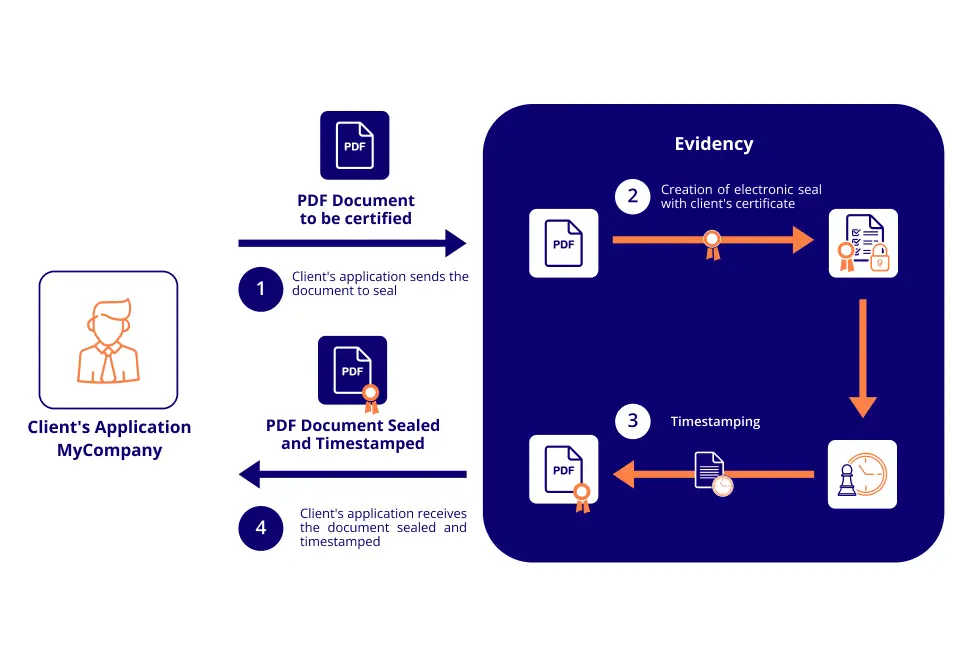
The client application transmits the document to be sealed to the Evidency service via API, which applies an electronic seal using the certificate of the issuing organisation.
The document is then timestamped to establish a reliable date and returned to the client application as a sealed and timestamped file, ready to be used and retained for evidential purposes.

An electronic sealing solution
designed for developers
The electronic seal integrates directly into your applications to guarantee the origin and integrity of your documents. Implementation is facilitated through a REST API, a dedicated sandbox and SDKs, designed to simplify interactions with the Evidency platform and to accommodate your technical constraints.
eIDAS-compliant electronic seal
With a single API call, a PDF document is sealed in accordance with ETSI EN 319 142 (PAdES), as referenced by the eIDAS Regulation. The service allows either the application of the Evidency seal as a trusted third party or the application of a seal in the name of your organisation.
This latter option requires the use of a certificate issued by a certification authority, a step for which our teams provide support (in particular for the generation of the required technical prerequisites, such as the CSR).
Time savings for your technical teams
Evidency services are designed to reduce development effort and enable your teams to focus on business integration. API call examples are available in several programming languages to secure and accelerate implementation.
Sandbox
Validate your integrations and identify any potential blocking points using the sandbox.
Documentation
Rely on comprehensive documentation to make full use of the features offered by our APIs and SDKs.
The electronic seal
in support of document fraud prevention

Preventing attempts at document fraud
The electronic seal acts as a deterrent against the alteration, manipulation or substitution of digital documents.
By sealing the content at the time of issuance and linking the document to the identity of the issuer, it enables any modification to be detected immediately and limits subsequent challenges.
Ensuring document compliance and traceability
Compliant with the eIDAS Regulation and delivered by a Qualified Trust Service Provider (QTSP) qualified by ANSSI, the Evidency service operates within a legal framework recognised under French and European law.
The qualified timestamp associated with each seal enables operations to be traced over time and, where appropriate, the production of evidentiary material usable in the context of an inspection, audit or litigation.
Our priority:
Trust and security
As a qualified Trust Service Provider (TSP), our solutions meet ANSSI’s regulatory, technical, and security requirements in accordance with eIDAS regulations, as well as the ISO 27001 standard.
Thanks to our centralised approach, we offer seamless integration and simplified digital trust management.

Secure all your
PDF documents
The Evidency electronic seal secures a wide range of documents and provides a level of protection aligned with fraud-related risks.
Contracts
Invoices
Quotes
Reports
Certificates
Legal documents
Online investigations
Confidentiality agreements
Purchase orders
Receipts
Pay slips
Tax assessments
Use cases
Managing trust in pratice

Promotional prices
Date and archive all reference prices to prove compliance with the European Omnibus Directive.
› Use case Prix promotionnels

Supply Chain
Ensure traceability, security, timeliness and quality of your products at each stage of your supply chain.
› Use case Supply Chain

Document fraud
Provide legally valid proof of existence for your invoices, audit reports, contracts, diplomas, consents, etc.
› Use case Document fraud
Are you looking to strengthen the evidential value of your digital documents?
Do you wish to implement fraud-prevention mechanisms?
Evidency’s experts are available to guide you.
FAQ
Electronic seal
What is an electronic seal?
Definition of electronic seal: an electronic seal is a digital security mechanism that guarantees the authenticity (origin) and integrity of a document issued by a legal entity, unlike an electronic signature, which binds an individual, or natural person.
There are three levels of electronic seal: simple, advanced, and qualified.
What are the types of electronic seals?
The concept of an electronic seal covers three distinct levels:
- Simple electronic seal: the basic level, relying on a simple identification procedure, sufficient for securing less sensitive documents.
- Advanced electronic seal: requires more rigorous identification, providing better traceability and enhanced security, recommended for important documents such as contracts or agreements.
- Qualified electronic seal: the highest level, based on strong identification and cryptography; it carries a presumption of legal reliability and is ideal for sensitive or regulated documents (such as electronic invoicing).
eIDAS qualification means that the electronic seal complies with the highest level of digital security defined by the European Union. In practice, this means it is issued by a certified provider (a Qualified Trust Service Provider – QTSP) and ensures the document is authentic and has not been altered.
With a qualified electronic seal, businesses benefit from legal recognition across the EU: the sealed document has the same value as a signed paper original and cannot be refused as evidence.
What is the difference between an electronic seal and an electronic signature?
Both the electronic signature and the electronic seal ensure the authenticity and integrity of a digital document, but they apply to different actors:
- Electronic signature: used by natural persons. It directly binds an individual (an employee, an executive, or a private person) who signs a document, thereby expressing their consent.
- Electronic seal: used by legal entities (companies, public authorities, associations). It authenticates a document as originating from the organisation itself, without binding any specific individual.
In short: an electronic signature binds an individual, while an electronic seal binds an organisation.
How does an electronic seal work?
An electronic seal is based on asymmetric cryptography and follows several steps:
- Generation of the digital fingerprint (hash): the document is transformed into a unique digital fingerprint using a hashing algorithm. This fingerprint changes if even a single byte is modified, thereby ensuring document integrity.
- Application of the seal: the fingerprint is then encrypted with a private key held by the organisation (via a certificate issued by a Trust Service Provider). This establishes the link between the document and the issuing legal entity, ensuring authenticity.
- Verification: anyone receiving the document can use the corresponding public key to decrypt the fingerprint and verify it matches the received document. If they correspond, the document is both authentic and intact.
In summary, an electronic seal functions as a digital stamp based on cryptography: it certifies that the document originates from an identified organisation (authenticity) and has not been altered since issuance (integrity).
How can I obtain a qualified electronic certificate?
To obtain a qualified electronic certificate, an organisation must go through a Qualified Trust Service Provider (QTSP) accredited by the relevant authorities (in France, ANSSI). These providers issue a qualified electronic certificate, which forms the basis of the seal and guarantees compliance with the eIDAS Regulation.
The process generally involves three steps:
- Selecting the trust service provider: choosing a recognised QTSP authorised to issue qualified certificates.
- Organisation verification: the provider validates the legal identity of the organisation to ensure the authenticity of the certificate.
- Issuance of the qualified electronic certificate: once delivered, the organisation can apply qualified electronic seals to its documents, ensuring authenticity, integrity, and full legal validity across the EU.
How to verify an electronic seal?
To verify an electronic seal affixed to a PDF, the most straightforward approach is to check the cryptographic validity of the seal, the identity of the issuer as indicated in the certificate, and the integrity of the document since the seal was applied (any modification invalidates the seal).
- Open the PDF in a compatible reader (e.g. Adobe Acrobat Reader): the seal appears in the “Signatures” / “Certificates” panel, and the software indicates whether the document is “signed/sealed and all signatures are valid” or, conversely, whether the seal is invalid.
- Verify the certificate: display the details of the certificate used for the seal and check the company name (or entity) identified as the issuer, the validity period, and the chain of trust (certification authority).
- Check integrity: ensure that the reader indicates “document has not been modified since the signature/seal”. If the PDF has been altered subsequently (even marginally), the seal must appear as invalid.
What types of documents can be secured with an electronic seal?
An electronic seal can be applied to any document requiring authenticity, integrity, and legal validity. It is particularly suited to:
- Administrative documents: certificates, reports, internal agreements, etc.
- Legal documents: contracts, articles of association, minutes, legal certificates.
- Financial and accounting documents: declarations, balance sheets, electronic invoices, and any documents subject to regulatory archiving.
In practice, the electronic seal secures any document issued by an organisation, guaranteeing that it originates from the issuing legal entity and has not been tampered with.
What are the benefits of an electronic seal for businesses?
Electronic seals offer several key advantages:
- Security: ensuring the authenticity and integrity of documents, protecting against forgery or unauthorised modifications.
- Traceability: each seal application creates a timestamped record, enabling tracking of the history and validity of documents.
- Time efficiency: simplifying and accelerating document management by replacing slow, paper-based procedures.
- Legal value: documents sealed with an eIDAS-qualified electronic seal enjoy EU-wide legal recognition, with a presumption of reliability in court.
Is the electronic seal legally recognised?
Yes. An electronic seal, when qualified and compliant with the eIDAS Regulation, has legally recognised validity across the European Union. A qualified electronic seal guarantees that the document originates from an identified organisation and has not been altered.
In practice, a document sealed with a qualified electronic seal has the same legal value as an official paper document and may be used as evidence before courts in all EU countries.
How can I integrate an electronic seal into my processes?
Electronic seals can be integrated directly into your IT systems via our API, allowing documents to be securely sealed without disrupting existing workflows.
To test and validate integration, you can also use our sandbox environment, which simulates the sealing process on your documents before going live. This approach ensures fast, reliable, and eIDAS-compliant adoption while optimising operational processes.
What are the criteria for a trust service provider to issue an electronic certificate?
To issue a qualified electronic certificate, a trust service provider must comply with strict requirements defined by the eIDAS Regulation and, in France, be certified by ANSSI.
These include:
- Mastery of advanced cryptographic mechanisms to guarantee authenticity and integrity of certificates.
- Implementation of rigorous security procedures to protect keys and issued certificates.
- Compliance with regulatory standards and regular audits of systems to ensure the legal reliability of electronic certificates.