

Key takeaways on CLM
- Contract lifecycle management (CLM) enables the structured organisation and effective oversight of the contract lifecycle, from drafting through to archiving.
- CLM tools enhance contractual governance by centralising documents, workflows and key dates.
- The traceability provided by a CLM is primarily operational in nature and does not always ensure evidential value that is enforceable in the event of a dispute.
- Internal logs and audit trails generated by a CLM may be challenged if they are not protected against alteration and do not meet legally recognised qualification requirements.
- Qualified timestamping and electronic seals complement CLM solutions by strengthening legal traceability and the evidential weight of key contractual events.
What is contract lifecycle management?
Contract lifecycle management refers to all the processes and systems used to manage the lifecycle of contracts, from their creation to their archiving. It is part of a structured approach to contract management, aimed at organising the flows, responsibilities and documents associated with each key stage in the life of a contract.
A CLM tool generally operates at several levels:
- organisational, by structuring approval processes and responsibilities;
- documentary, by centralising contracts and managing versions;
- collaborative, by facilitating exchanges between legal, business and finance departments.
CLMs incorporate traceability mechanisms such as action logs, metadata and change histories. These elements provide useful traceability for contract management. However, their legal scope must be assessed according to the context in which they are produced and used.
The five main stages of the contract lifecycle in a CLM
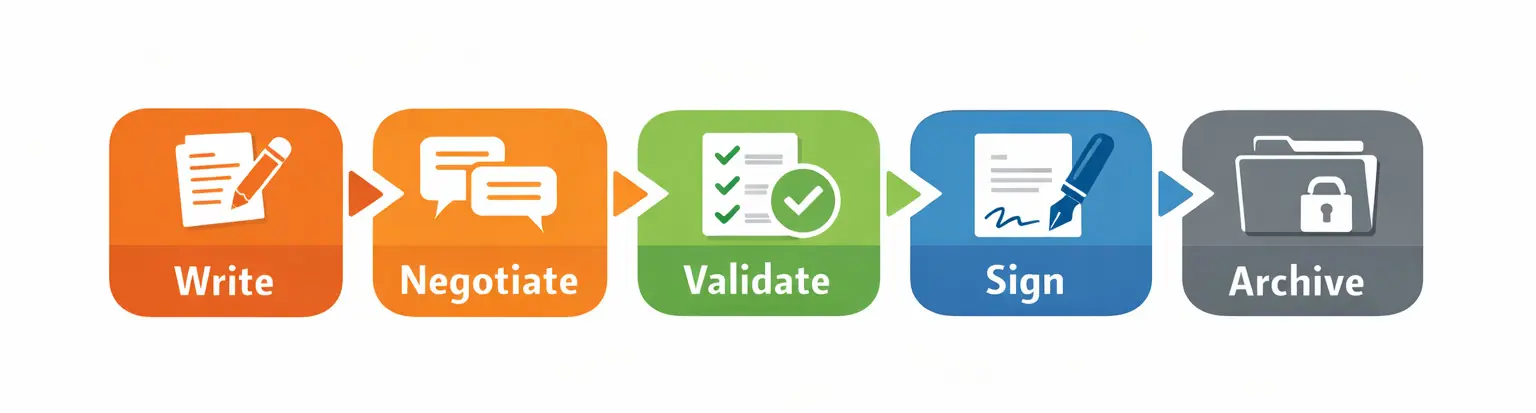
Traditionally, the contract lifecycle followed in a contract lifecycle management system is structured around five main stages. This organisation allows a contract to be tracked continuously, from its creation to its closure, keeping a record of successive decisions and events.
- Drafting and negotiating the contract: this phase covers the creation of the contractual document, exchanges between the parties and the management of successive versions. It is iterative in nature, as the content of the contract may evolve during discussions until a text that is acceptable to all parties is agreed upon.
- Internal validation: once the text has been negotiated, the contract is submitted to the validation channels defined by the organisation (legal department, business lines, finance). This step may also be iterative when adjustments are requested and validations are not granted as is, resulting in new versions of the document before its conclusion.
- Signature and entry into force: once validated, the contract is signed by the parties. The CLM keeps the final version of the document and information relating to its date of entry into force.
- Contract execution and amendments: this phase involves monitoring contractual obligations, managing contractual amendments and any changes that may occur during execution.
- End of contract and archiving: the contract expires, is terminated or renewed. The documents are then archived and the contract file is closed.
Each of these stages generates dated events which, depending on the situation, may become points of analysis or legal discussion in the event of a dispute, audit or inspection.
The advantages of CLM for legal professionals and contract managers
CLM enables legal departments to store all contracts in a single space, accessible to teams via a single entry point. This organisation facilitates coordinated version management and limits the risks associated with scattered files or the use of outdated documents. The use of CLM thus results in greater efficiency in the day-to-day processing of contractual files.
In this regard, a study published by WorldCC (formerly IACCM) indicates that the use of contract lifecycle management systems can reduce the time spent on contract management by 30 to 50%, in particular through the standardisation and automation of contractual processes[1].
CLM also facilitates the monitoring of contractual deadlines. Legal professionals and contract managers have a consolidated view of key dates, associated with alerts, which allows them to anticipate renewals, renegotiations or contract terminations and ensure compliance with contractual obligations over the long term.
By structuring information and deadlines, CLM contributes to better contract governance.
But while a CLM significantly improves contractual governance, one question remains: is the traceability it provides sufficient, on its own, to establish indisputable proof in the event of a dispute?
Contractual traceability and evidence: points to watch out for and targeted contributions from trusted services
This improvement in contractual governance raises questions about the probative value of the traces and logs produced by a CLM, particularly when these elements are likely to be contested.
Caution regarding the probative value of CLMs
The action logs generated by a CLM constitute internal traceability elements. In the event of a dispute, however, their probative robustness depends on the conditions under which this information was produced, stored and protected against any alteration. The question of data integrity and its enforceability against third parties then becomes central, particularly in contexts with high legal stakes.
Qualified timestamping and the eIDAS framework: reinforcement of contractual traceability
Action logs are most often based on timestamps generated by the systems themselves, the reliability of which depends on the technical and legal framework in which they are used.
In this context, the use of a qualified timestamp within the meaning of the eIDAS Regulation provides recognised legal guarantees in terms of certainty of date and integrity. Applied to documents or key events in the contract cycle, it aims to strengthen their enforceability when a higher level of legal certainty is required.
These mechanisms are not a substitute for CLM. They are complementary, intervening in a targeted manner when the traceability provided by internal systems needs to be secured in the face of a risk of dispute, particularly in the event of litigation, audit or regulatory control.
Conclusion
Contract lifecycle management (CLM) has become a standard in corporate contract management, responding to the organisational challenges faced by legal departments. It enables them to better manage contractual commitments and control their lifecycle.
However, proof of contractual events is a different matter. The issue is not to oppose CLM and probative mechanisms, but to identify when and why their combination is relevant in order to ensure the traceability of contracts and unchallengeable proof of contractual commitments when legal issues require it.
Evidency is an eIDAS-qualified Trusted Service Provider certified by ANSSI. Its qualified timestamping and electronic seal solutions are tailored to the business needs of its customers and guarantee the traceability, integrity, authenticity and admissibility of their data over time.
References:
[1] https://www.worldcc.com/Resources/Research/Contracting-Excellence
Disclaimer
The opinions, presentations, figures and estimates set forth on the website including in the blog are for informational purposes only and should not be construed as legal advice. For legal advice you should contact a legal professional in your jurisdiction.
The use of any content on this website, including in this blog, for any commercial purposes, including resale, is prohibited, unless permission is first obtained from Evidency. Request for permission should state the purpose and the extent of the reproduction. For non-commercial purposes, all material in this publication may be freely quoted or reprinted, but acknowledgement is required, together with a link to this website.