

Key takeaways about traceability in digital registered mail
- Registered mail serves an evidential function: it is used to prove that a legally significant communication was sent and received.
- The evidential value of registered mail is based on three requirements: integrity of the content, certainty of date and time, and authenticity of origin.
- Digital registered mail can only be relied upon in legal or regulatory contexts if it preserves these three evidential requirements throughout the process.
- Users of digital registered mail should ensure that their provider integrates eIDAS-qualified timestamping into the registered email workflow to secure legal equivalence with paper-based registered post.
- This requirement is especially relevant for cross-border communications, where postal delivery provides weaker traceability and higher evidential uncertainty.
The evidential function of registered mail in UK legal practice
Registered mail operates as an evidential mechanism rather than a simple delivery service. Its purpose is to support enforceable legal positions by creating traceable proof that a specific document was sent and received within a defined timeframe.
In UK practice, registered or recorded delivery is frequently relied upon for communications that may later be scrutinised by a court. These include contractual termination notices, formal demands, employment-related correspondence, regulatory notifications and pre-action letters. In each scenario, the sender anticipates potential dispute and seeks to secure evidence in advance.
From an evidential standpoint, registered mail is intended to support three elements: proof of dispatch, proof of receipt, and certainty as to the integrity of the content transmitted. When any of these elements is uncertain, the evidential value of the communication is weakened.
Structural limits of traditional registered mail
Despite its continued use, paper-based registered mail presents limitations that are increasingly misaligned with digital legal workflows.
The process requires physical intervention at both ends. The sender must attend a post office to register the item. The recipient must be present to receive it or arrange redelivery. Missed deliveries and delays are common, particularly where recipients are unavailable.
The model is also territorial. Domestic postal systems provide a degree of traceability, but reliability diminishes for international deliveries. Delivery timelines vary significantly, and proof of receipt may be delayed or incomplete.
Cost and scalability present further issues. As volumes increase, postal registered mail becomes administratively heavy and expensive. Private carriers may offer international tracking, but they cannot always provide undisputable proof of receipt by the intended recipient, which undermines evidential certainty.
The legal question raised by digital correspondence
Most legally significant communications already exist in digital form. Contracts, notices and regulatory correspondence are drafted, stored and managed electronically. Yet organisations often revert to paper-based registered mail solely to preserve evidential certainty.
This raises a precise legal question: can digital correspondence provide legally reliable proof of sending and receipt, comparable to registered mail, without relying on postal infrastructure?
From an evidential perspective, the issue is not the medium itself, but the ability to demonstrate traceability, integrity and timing in a manner that can withstand scrutiny. Without these elements, digital delivery remains vulnerable to challenge, particularly in contentious or cross-border situations.
Digital registered mail as an evidential workflow
Digital registered mail seeks to reproduce the evidential function of registered post, not merely its convenience. The objective is to create a structured digital process capable of generating admissible electronic evidence that can be relied upon in disputes and litigation.
Rather than focusing on physical delivery, the process centres on traceable digital events. Sending, receipt and opening are treated as legally relevant stages, each capable of being recorded and verified. The evidential focus shifts from location to chronology and integrity.
A shift from delivery to traceability in digital registered mail
This approach aligns more closely with evidential reasoning. What matters is the ability to demonstrate that a specific document existed in a specific form at a specific time, and that it was made available to the intended recipient without alteration. When supported by appropriate trust services, digital registered mail can meet these evidential expectations.
The Postclic use case: securing digital registered mail
Postclic has developed a digital registered mail platform designed to address these evidential requirements. The service enables users to send registered communications to any recipient with an email address, replacing postal delivery with a fully digital workflow.
To secure traceability and integrity, Postclic integrated Evidency’s eIDAS-qualified timestamping service into its platform. Each message is assigned a unique identifier and tracked throughout its lifecycle.
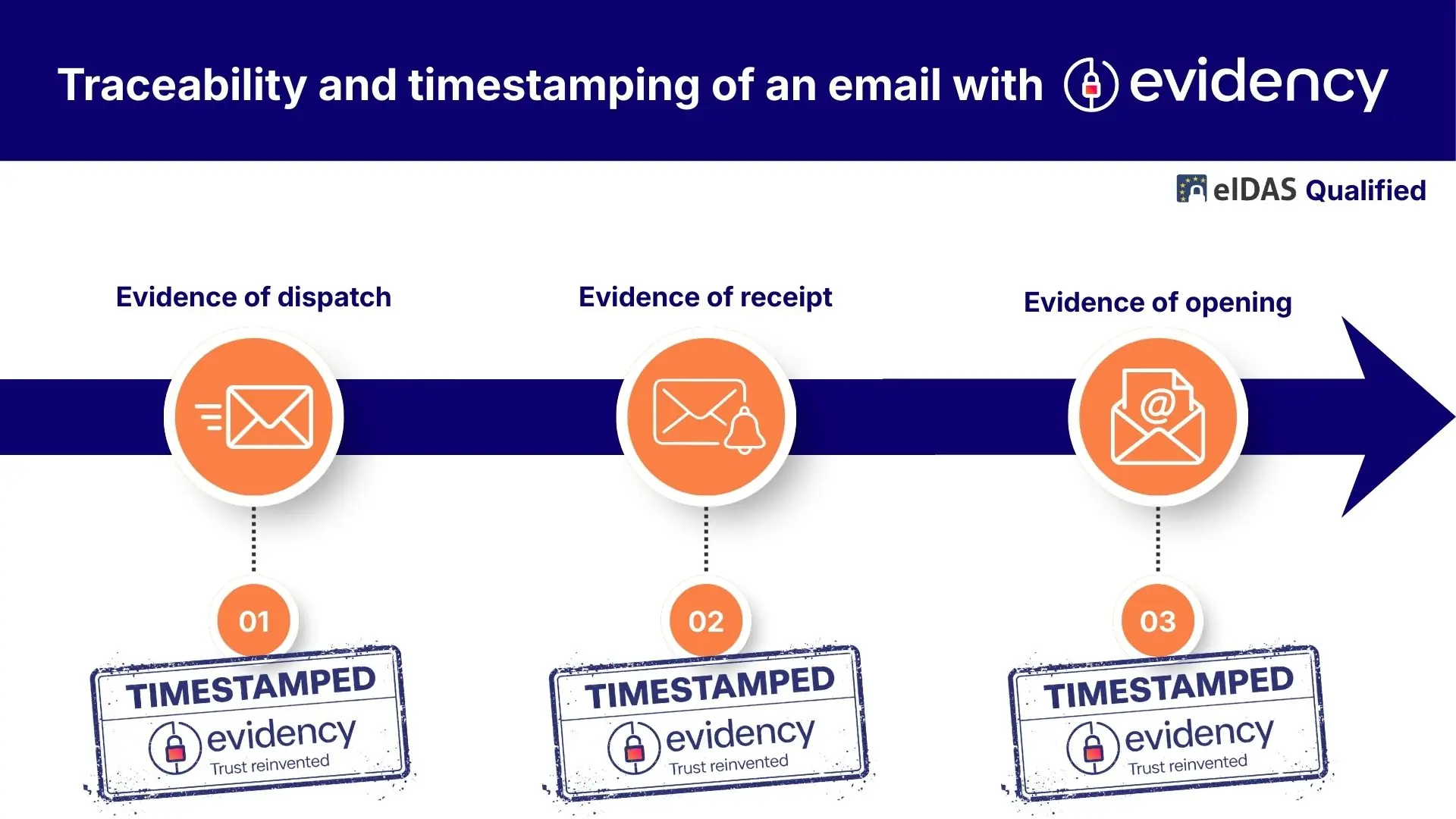
At each legally relevant stage (dispatch, receipt and opening), a qualified timestamp is automatically applied to the transaction via Evidency.
These timestamps anchor events to a legally recognised time reference and act as a proof of delivery. In parallel, a cryptographic hash guarantees that the content has not been altered between sending and receipt. Any modification would invalidate the timestamp and reveal tampering.
Qualified timestamping and evidential certainty
Qualified timestamping plays a central role in transforming digital delivery into legally defensible proof.
Under the eIDAS framework, a qualified electronic timestamp provides a legally recognised date and time and benefits from a presumption of accuracy as to that timing. When applied to digital registered mail, it allows each stage of the communication process to be anchored to a trusted temporal reference.
In the Postclic workflow, timestamping operates as part of a broader electronic evidence audit trail. Unique identifiers, content hashing and event logs combine to produce structured evidence that can be examined in the event of a dispute. This approach supports theevidential value of digital communications without reliance on postal infrastructure.
Evidential outcomes and litigation readiness
By relying on qualified trust services, Postclic’s digital registered mail solution delivers evidential outcomes comparable to traditional registered post.
Organisations obtain worldwide traceability, independent of national postal systems. They can demonstrate proof of sending and receipt, as well as proof of integrity, for each communication. The resulting evidential file is time-anchored, coherent and resistant to challenge.
In litigation or regulatory disputes, this reduces scope for arguments based on non-receipt or delayed delivery. It also supports compliance obligations where notification must be proven. From a procedural standpoint, the ability to produce an intelligible and verifiable audit trail strengthens legal positions.
Conclusion: evidential requirements for digital registered mail
When a document or a process carries legal consequences, its evidential value rests on three elements: integrity, date, and authenticity. These elements determine whether a communication can be relied upon in a dispute, an audit or a regulatory review, to show that the document has not been altered, that it existed at a specific time, and that its origin can be clearly identified.
Registered mail embodies a dual evidential necessity. It is typically applied to documents that already carry legal or contractual weight. At the same time, the delivery process itself becomes evidence, allowing the sender to prove that the communication was delivered, and when.
For digital registered mail to offer the same legal standing as paper-based registered post, these evidential guarantees must be preserved. Users should therefore ensure that the provider they select integrates eIDAS-qualified timestamping into the registered email process. Qualified timestamping provides the highest recognised level of proof of time and integrity in the EU and is relied upon in the UK legal environment. This requirement is particularly important for cross-border communications, where traditional postal traceability is weakest.
Disclaimer
The opinions, presentations, figures and estimates set forth on the website including in the blog are for informational purposes only and should not be construed as legal advice. For legal advice you should contact a legal professional in your jurisdiction.
The use of any content on this website, including in this blog, for any commercial purposes, including resale, is prohibited, unless permission is first obtained from Evidency. Request for permission should state the purpose and the extent of the reproduction. For non-commercial purposes, all material in this publication may be freely quoted or reprinted, but acknowledgement is required, together with a link to this website.