
Ensure a reliable audit trail
with qualified timestamping

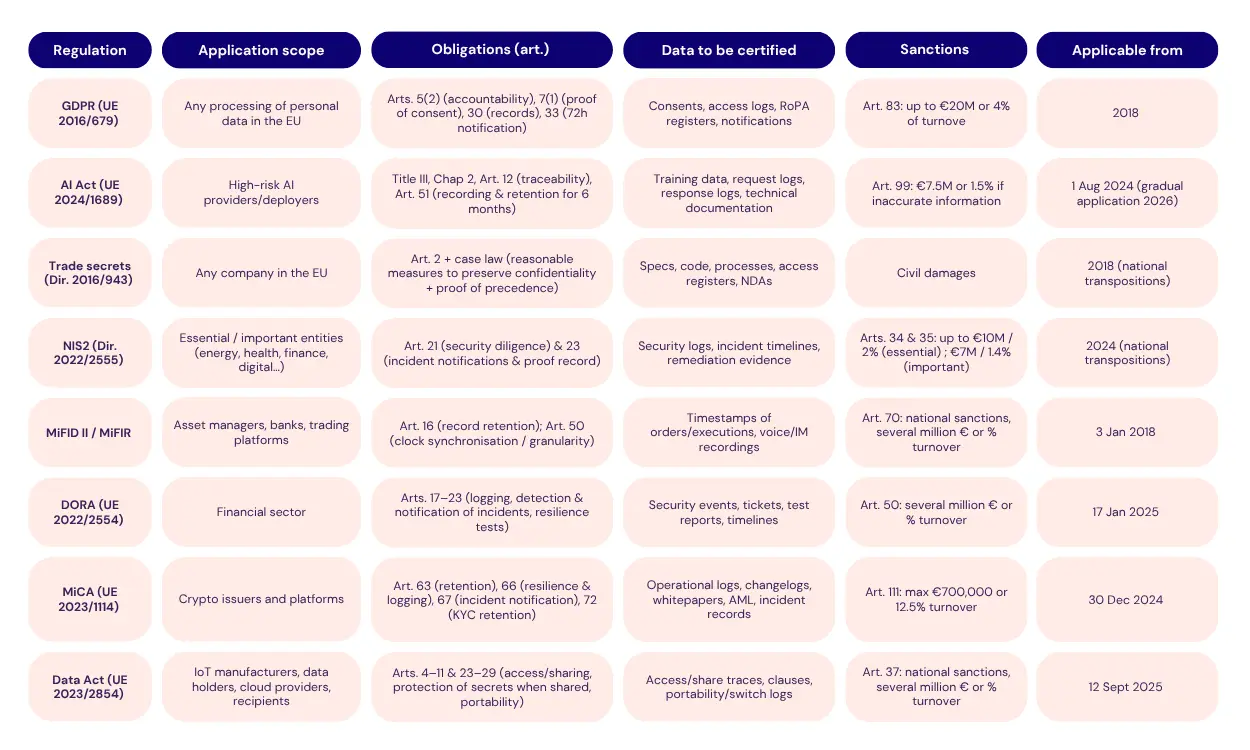
In an increasingly demanding regulatory environment (AI Act, GDPR, NIS2, MiFID II/MiFIR, DORA, MiCA, Data Act…), businesses must demonstrate the traceability, authenticity, and above all the integrity of their critical data.
Qualified timestamping, as defined by the eIDAS regulation, enables compliance with these requirements. By recording the fingerprint (hash) of each strategic event or data point via API, organisations gain legally admissible evidence: the date and time are legally presumed accurate, and the integrity of the content is guaranteed.
Qualified Timestamping:
twofold benefits

Legal advantage
Qualified eIDAS timestamping provides legally admissible evidence during inspections, audits, or litigation. Under the eIDAS regulation, it carries a presumption of reliability and shifts the burden of proof to anyone who disputes it.

Operational advantage
Qualified timestamping helps streamline verification processes and reduces exposure to penalties when compliance can be demonstrated.
Rising data volumes
to trace and prove
Evidency’s qualified timestamping integrates at scale via API into your business systems to ensure a reliable audit trail across all critical data flows:
- ERP / Finance: orders, invoices, accounting closures, journal entries
- Trading / MiFID: orders, executions, cancellations, voice or instant messaging records
- AI & data: dataset versions, models, artefacts, inference logs
- Security / Incidents (NIS2 / DORA): SIEM logs, incident timelines, alert notifications
- R&D / Industry: specifications, test reports, validations, PLM/MES, laboratory notebooks
- Legal / Contracts: consents, NDAs, amendments, proof of notification
- Crypto / MiCA: operational logs, transactions, compliance reports
Depending on the size and sector of the organisation, these flows can represent several million, or even tens of millions, of events per year. Qualified timestamping automates the generation of legally admissible proof, ensuring complete traceability that is enforceable and compliant with European regulations.

Overview of regulatory requirements
for digital evidence
How does it work?
Step 1
Identifying the company’s specific requirements
Step 2
Connection between the Evidency system and the client system via a REST API
Step 3
The client system hashes the data and sends the hash to be timestamped
Step 4
Evidency timestamps the unique hash and returns the timestamp token to the client
Speak with our legal experts for guidance on the regulations affecting your sector
FAQ
Reliable audit trail
What is the purpose of a reliable audit trail?
A reliable audit trail makes it possible to reconstruct, in a coherent manner, the origin, processing and destination of a document or data flow. It ensures that operations are recorded in a complete, chronological and tamper-evident manner, which is necessary to meet compliance obligations, particularly in relation to electronic invoicing or tax audits. By securing digital evidence, it reduces the risk of disputes and facilitates both internal and external audit procedures.
How should a reliable audit trail be documented?
The documentation of a reliable audit trail relies on the systematic recording of key events: the creation, modification, validation and transmission of documents. This documentation must be securely timestamped, associated with clearly identified actors, and preserved under conditions that ensure its integrity. Combining technical mechanisms (such as timestamping and electronic signatures) with formalised internal procedures enables organisations to establish an audit trail that is structured, compliant and verifiable.
Who is concerned by the requirement for a reliable audit trail?
Any organisation handling documents or data flows subject to traceability or compliance requirements is concerned.
This includes, in particular:
- organisations subject to electronic invoicing obligations,
- entities operating in regulated sectors,
- companies subject to strict retention or internal control requirements.
A reliable audit trail becomes an effective risk-governance mechanism for organisations that must demonstrate the consistency and transparency of their documentary processes.