
Key takeaways
- 2D Doc secures data encoded within a 2D barcode, readable using a dedicated scanner. It is particularly useful for supporting documents frequently exposed to falsification (e.g. identity cards, tax documents, invoices).
- Electronic seals are governed by the eIDAS Regulation and seal a file in the name of a legal person, according to three assurance levels (simple, advanced and qualified).
- Both mechanisms aim to reduce fraud risk, but the electronic seal applies to the entire document, not merely to a subset of data.
- 2D Doc appears visibly on the document, whereas the electronic seal is embedded within the file metadata.
- An electronic seal may be combined with timestamping to strengthen the argument for a reliable date in the event of dispute (evidential logic: date, integrity and origin).
- Qualified trust services within the meaning of the eIDAS Regulation benefit from a legal presumption of integrity and origin recognised throughout the European Union.
Two mechanisms, two technical approaches: 2D Doc and electronic seals
To understand the distinction between the two mechanisms, it is necessary to understand what they actually secure: 2D Doc verifies encoded data, whereas the electronic seal seals an entire file.
2D Doc: a barcode designed to combat fraud
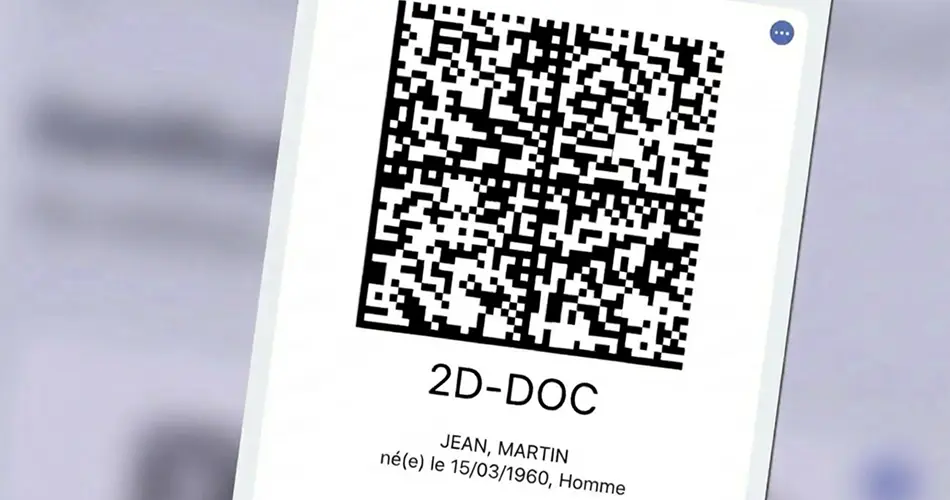
2D Doc is a standard created in 2012 by ANTS (France Titres) to reduce the falsification of paper or PDF supporting documents. It takes the form of a two-dimensional barcode (Datamatrix) affixed to a document. Its use falls within a specifically French legal framework (Order of 27 September 2013 and the security framework linked to the Référentiel Général de Sécurité (RGS)), which clarifies its purpose: facilitating verification of a transmitted, printed or rescanned document, and reducing alterations that may otherwise go unnoticed during visual inspection.
In practice, the code contains key data (name, address, amount) signed using a private key; authenticity is verified through the corresponding public key. The operational objective is straightforward: rapid verification through Datamatrix reading, without requiring consultation of a central database. In other words, 2D Doc primarily addresses field-verification requirements for standardised, widely circulated documents.
How is a 2D Doc verified?
The barcode is visible on the document and can be verified easily using a dedicated smartphone application referenced by France Titres, or by barcode scanners in professional environments. No connection to a central database is required. The result is immediate: green indicates the document is authentic; red indicates that it cannot be regarded as reliable.
This point should nevertheless be expressed clearly: verification only applies to the Datamatrix perimeter. The process checks consistency between the encoded data and the displayed data. Consequently, any modification affecting an element outside that perimeter is not, in itself, detectable through 2D Doc verification.
Electronic seals: the digital seal of a legal person
The electronic seal is defined in Article 3(25) of the eIDAS Regulation. It is a cryptographic mechanism enabling an organisation (legal person) to guarantee that it is the originator of a document and that its contents have not been altered. It exists at three assurance levels: simple, advanced and qualified.
The seal is embedded within the file and applies to the document as a whole. In practice, verification is performed through the file’s signature/seal properties (particularly in PDFs). This architecture explains why electronic seals are naturally suited to natively digital documents, including those generated at scale or requiring subsequent production with an auditable verification trail. Electronic seals are sometimes compared to the enveloppe Soleau, insofar as they provide, in the event of litigation, evidence of origin and integrity capable of being relied upon.
Scope of application and evidential effect
2D Doc operates within a French legal framework, whereas qualified electronic seals are recognised throughout all 27 Member States of the European Union.
2D Doc: a French mechanism for verifying widely circulated supporting documents
Material scope
Initially designed to facilitate administrative checks, 2D Doc now appears on a broad range of widely circulated supporting documents. These include utility and telecommunications invoices, bank account details (RIBs), payslips, tax notices, the French national identity card (since 2021) and Crit’Air certificates.
Territorial scope
Le 2D Doc s’inscrit dans un cadre d’usage strictement national. Il ne relève pas des services de confiance qualifiés au sens d’eIDAS, mais peut toutefois constituer un élément de preuve recevable auprès des juridictions françaises, dès lors qu’il permet d’établir la cohérence et l’intégrité des données encodées.
Absence of eIDAS legal presumption
The evidential scope of 2D Doc remains limited: it does not benefit from any eIDAS presumption, and verification is restricted to the fields encoded within the Datamatrix. Accordingly, any alteration affecting an element outside this perimeter cannot be detected through 2D Doc verification.
Electronic seals: a reliable mechanism applicable to any electronic document
Material scope
Electronic seals may be applied to any electronic document for which a legal person seeks to guarantee origin and integrity: contracts, digital archives, compliance files, source code files and technical reports. Their scope is not restricted to predefined document categories.
Territorial scope and attached presumption
Electronic seals have European effect: a qualified electronic seal is recognised as a matter of law throughout all 27 Member States of the European Union, without additional formalities. Article 35 of the eIDAS Regulation grants qualified electronic seals a presumption of data integrity and correctness of origin, and further provides that no court may refuse legal effect solely because the seal is in electronic form.
In practice, this means that where a party seeks to challenge the origin or integrity of the document, it falls to that party to provide evidence capable of substantiating the challenge.
How to choose your provider
The process of choosing a Trust Service Provider takes place in two stages.
First, determine the required assurance level (simple, advanced or qualified) according to the level of risk involved (audit, litigation, cross-border use) and the intended evidential effect.
Second, assess the implementation framework: API integration for high-volume processing, supervision capabilities, retention of technical evidence, and above all the ability to produce intelligible evidence (case file, verification elements and access mechanisms).
Summary table comparing 2D Doc and Electronic Seal
| Criteria | 2D Doc | Electronic seal with Qualified Timestamping |
|---|---|---|
| Prupose | Combating documentary fraud | Guaranteeing integrity, origin and date of an electronic document |
| Medium | Paper and digital | Digital only |
| Visibility | Printed barcode visible on the document | Embedded within metadata |
| What is secured | Predetermined fields encoded in the Datamatrix | Entire electronic file |
| Legal framework | French law (Decree No. 2013-629, RGS) | Regulation (EU) No. 910/2014 (eIDAS) |
| Evidential effect | Integrity of signed fields under the RGS; no eIDAS legal presumption | Legal presumption of integrity and origin (Art. 35); reliable date (Arts. 41-42 eIDAS) |
| Territorial scope | France only | 27 EU Member States |
| Scalability | ANTS issuer registration required | High-volume processing through API |
References
Règlement (UE) n° 910/2014 du 23 juillet 2014 (eIDAS), art. 3 § 25, art. 35 et art. 42.
Arrêté du 27 septembre 2013 relatif à l’insertion d’un code-barres 2D dénommé « 2D-doc » dans les pièces justificatives.
Référentiel général de sécurité (RGS).
France Titres (ANTS), 2D Doc, page institutionnelle, 2024
France Titres (ANTS), 2D-DOC – Spécifications techniques des Codes à Barres 2D-DOC, version 3.3.4, 2024
Éric A. Caprioli, Signature électronique et dématérialisation, LexisNexis, coll. « Droit & Professionnels » (chap. « Cachet électronique », p. 163–166).
Éric A. Caprioli, « Les prestataires de services de confiance (PSCo) dans le contexte du règlement eIDAS », Dalloz IP/IT, 2024, p. 452 s.
Disclaimer
The opinions, presentations, figures and estimates set forth on the website including in the blog are for informational purposes only and should not be construed as legal advice. For legal advice you should contact a legal professional in your jurisdiction.
The use of any content on this website, including in this blog, for any commercial purposes, including resale, is prohibited, unless permission is first obtained from Evidency. Request for permission should state the purpose and the extent of the reproduction. For non-commercial purposes, all material in this publication may be freely quoted or reprinted, but acknowledgement is required, together with a link to this website.