
Timestamping API
Integrate eIDAS qualified timestamping into your applications
Connect your applications to the Evidency timestamping service via a secure API. Automatically generate qualified timestamp tokens that comply with the eIDAS Regulation and the RFC 3161 standard to guarantee the date and integrity of your data.

Integrate qualified timestamping
directly into your applications
eIDAS-compliant timestamping
Create qualified timestamp tokens that are legally recognised throughout the European Union.
Integration via REST API
Quickly integrate qualified timestamping into your applications using a REST API and detailed technical documentation.
Sandbox environment
Test your API calls and validate your integration in a sandbox environment before going live.
Confidentiality guaranteed
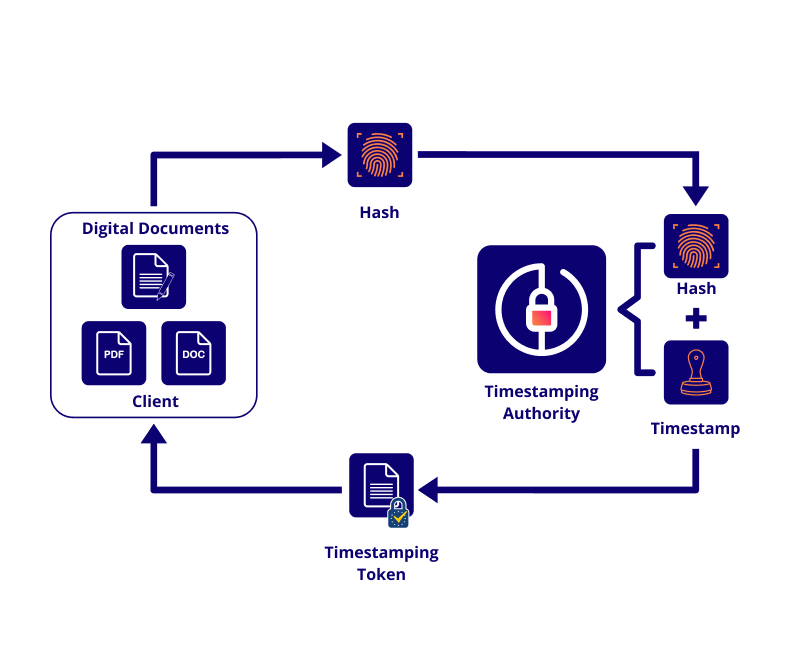
Only the cryptographic fingerprint (the hash) is sent to Evidency. The content of your documents does not need to leave your environment.
What is a
timestamping API?
A timestamping API is an interface that allows an application to automatically request an electronic timestamping service.
Its purpose is evidentiary. It serves to establish that a specific piece of data existed at a given date and time, and to verify at a later date that it has not been altered.
Timestamping API
How does it work?
Step 1 – Access the sandbox
Test the timestamping API in a dedicated environment before deploying it to production.
Step 2 – Integrate the API
Connect your application to the Evidency API using the technical documentation.
Step 3 – Send your requests
Your application automatically sends the data hashes to be timestamped via the REST API.
Step 4 – Receive the timestamp tokens
The qualified timestamp tokens are returned directly to your application.
Step 5 – Go live
Once the integration has been validated, deploy the service to your production environment.
Flat rate pricing
based on volume
From 500 euros excluding tax per month
Annual packages suitable for high volumes
No set-up fees
No limit on the number of users
Customer Support included
An integration designed
for developers
Evidency offers two distinct environments: a sandbox, intended for testing, and the production environment, where the qualified timestamping service is operated.
The integration process is intentionally short: create an account, generate an API key, create a timestamping project, and then make calls to the service. The documentation also provides integration examples and a reference for the available endpoints.
Sandbox
Test your API calls and validate your integration before going live.
Documentation
Find all the resources you need to integrate and use our APIs and SDKs.
FAQ
Timestamping API
What is the difference between a timestamp API and a simple computer timestamp?
A timestamp generated by an application records time-related information. A qualified electronic timestamp relies on a trusted third party and meets the requirements set forth in eIDAS. It thus benefits from the presumption defined in Article 41 of the regulation.
Is the Evidency API compatible with RFC 3161?
Yes. Evidency allows you to create a request that complies with the Time-Stamp Protocol (RFC 3161) and receive a corresponding timestamp response.
Should we send the document to Evidency?
For the timestamping service, the application can transmit the document’s cryptographic fingerprint, rather than its content. RFC 3161 specifically provides for the timestamping of this cryptographic representation.
Can we test the API before it goes live?
Yes. Evidency offers a sandbox specifically designed for testing and validating integrations. Tokens created in this environment must not be used for legal purposes.
Why integrate an eIDAS-compliant qualified timestamp via API?
For a legal, compliance, or audit department, the issue is not simply a matter of knowing the date on which an IT system indicates that a file was created. A date embedded in a file’s metadata can be altered.
The eIDAS qualified timestamp operates on a different principle. Article 41 of the eIDAS Regulation provides that it is presumed to accurately reflect the date and time indicated, as well as the integrity of the data to which they relate. Furthermore, a qualified timestamp issued in one Member State is recognised as such in the other Member States.
Article 42 requires, in particular, that the date and time be linked to the data in such a way that any alteration can be detected, and that they be based on a clock synchronised with Coordinated Universal Time (UTC).